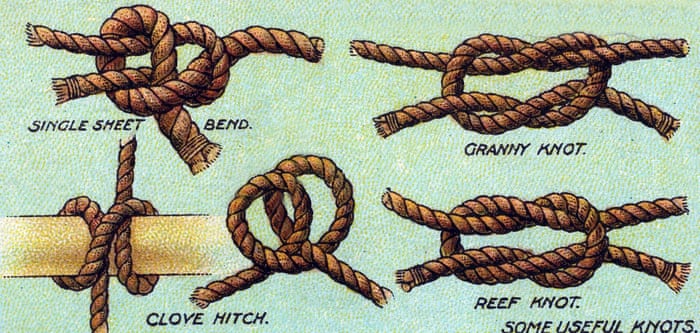
The action or craft of tying knots in yarn to make carpets or other decorative item is known as knotting. It is a preparation applied to knots in wooden boards prior to painting to prevent resin from oozing through, typically consisting of shellac dissolved in methylated spirits. KNOT-TYING has long been a part of the Scouting program for good reasons. It promotes discipline and focus, and it teaches useful skills that can be used immediately.
There are 6 basic knots that are used in scouting. They are Square Knot, Bowline knot, Clove hitch, half hitch, sheet bend, Taut line knot. Beside them; Alpine Butterfly, Bowline, Double Figure of Eight, Truckers Hitch, Timber Hitch, Zeppelin Bend, Carrick Bend, Reef Knot, Fisherman's Knot, Fireman's Chair, Round Turn and Two Half Hitches, Sheep Shank knots are also used in scouting.
Knots & Their Uses:
- A good knot holds but is easy to open if necessary.
- There are different knots for different purposes and all knots are not good for all purposes.
- Practice makes perfect.
- Good knot needs not to be complicated, use the simplest one good enough for the job.
- There is a difference in situations where there is constant pull on the rope or if it is sometimes loose and sometimes taut.
- Sometimes it is important to be able to open the knot, even if there is a heavy load on the line.
- Learn the difference of the wrong way to do it and the right way to do it, especially how the wrong way to do it causes the knot to slip or makes it difficult to open.
Types of Knotting:
1) Sheet bend (Sandhi Gaath) (also known as Weavers Knot):
The sheet bend (also known as becket bend, weaver's knot and weaver's hitch) is a bend. It is practical for joining lines of different diameter or rigidity. It is quick and easy to tie, and is considered so essential it is the first knot. Additionally, it is one of the six knots given in the International Guild of Knot Tyers' Six Knot Challenge, along with the clove hitch, bowline, reef knot (square knot), round turn and two half-hitches, and sheepshank. Fold one end of the thicker rope back on itself to form a bend or bite. That looks like a u-shape tipped on its left then slip one end of the thinner rope through the bend from behind.
It is used to join two different ropes with different size & thickness. It is very fast to tie. It is one of the easiest knot to work when slipped. It is very useful when joining two ropes of different diameters. Another feature of this bend is it doesn't slip under load. This knot is stronger when more pressure is applied and it can't be easily untied.
2) Reef Knot (also known as Square Knot):
The Square (Reef) Knot is usually learned when we tie the laces on our first pair of shoes. Admittedly it is usually a bow that we tie but the underlying knot is a Square (Reef) Knot. "You just go over on one side and then over again on the top and when you pull it tight. It's very symmetrical it's a square knot. It just goes over on one side and then over again on the top and when you pull it tight. It's very symmetrical it's a square knot."
It is intended to be a binding knot and, tied in the right material against a curved surface, the first Half Knot. Although it is easy to make it cannot be trusted. That is why surgeons use an extra turn in the first Half Knot to achieve the binding required while they prepare the second Half Knot. It is strictly a binding knot, reliable only when pressed against something else and tied in both ends of the same material so restrict its use to bandages and all sorts of parcels. It is mainly use as support when hand is fracture because this knot has plain base high surface area to reduce forced pain. Another important feature of this knot is it can be used as closing knot on all kind of knot. It can slip at any time. It can come undone under movement. It will capsize or jam under load. The reef knot should never be used as a bend to join two ropes that will be under load. The reef-knot is only useful in simple applications.
3) Clove hitch (Kila Paso Gaath) (also known as general utility hitch):
The nearest there is to a general utility hitch. It is easy to tie in a number of different ways and to untie. It has a wide variety of uses but care should be taken not to misuse it: It is so easy to use it when a more suitable hitch (e.g., a Rolling Hitch etc.) would serve better. The end of the rope around the pole. Continue across the standing end and around the pole a second time thread the end under itself and pull tight to form the clove hitch.
It is quick & easy to use. Its main feature is it can be performed with single rope and easy to open. It has very good grip in a slippery object like pole. This knot is used in 'Commando bridge' to cross the river. Even it has some advantages too so if you have to use it, work it up properly; pull length-wise only at both ends before you load the working end. The standing end should be secured if it is going to be used as an 'anchor' as it may work loose. If you have to use it, work it up properly; pull length-wise only at both ends before you load the working end. It is better to use the Rolling Hitch instead of this.
4) Sheep Shank:
The sheepshank is a simple knot useful for temporarily shortening a rope. It is made by making a double loop in the rope and tying a half hitch at each end. The sheepshank is designed to shorten a rope (without cutting it!). It can also be used to take up the slack in a rope. Another very useful purpose it serves (that people often overlook) is its ability to protect a weak or damaged section of the knot. Simply ensure that the damaged section forms the middle line of the sheepshank. The strain will be taken at either end and very little (or no) strain will be placed on the weakened part. Create a second overhand loop and tuck the second bite into that and let it be gently pull you have a sheepshank to untie you loosen the loops. And the rope is free. A damaged rope should always be replaced or retired from 'active use' and be used for knot tying practice only. If both ends are available pass them through the ends to stop the sheepshank from coming undone when not under tension.
It is easy to tie. This knot has many advantages it can increase strength of rope if the rope is going to be torn and it can protect weak portion of the rope. It is mainly used to carry buckets, utensils.
5) Fisher Man Knot (good quick bend):
The fisherman's knot is a bend (a knot for joining two lines) with a symmetrical structure consisting of two overhand knots, each tied around the standing part of the other. Not to be confused with the Fisherman's Bend (which is actually a hitch!). Take the end in your left hand and cross it over top of the end in your right hand and then take that same end that is now on the right-hand side and bring it behind. The ends can be taped down to prevent them working loose. The short ends must be at least five times the diameter of the rope. A double fisherman's knot can be used for more slippery or smaller diameter line.
Main importance of this grip is it have good grip. By using this knot we can lift any object easily. It is safe reliable and simple and effective.
6) Bowline (pronounced "boh-linn") (Dhurba Gaath):
The most useful and one of the simplest ways of putting a fixed loop in the end of a rope. It is easy to tie and to untie, it never slips nor jams and has a high breaking strength. It has been called the 'King of Knots'. Around the tree. Back down the hole. Then we're going to pinch both the ends of our running end grab our standing part. And pull both of them tight to create our bowline.
This knot has no chance of getting loose and unchained because it has very good grip. It is used to pull a person stuck inti down gorge or in a deep. It can be performed by single hand so we can tie it on any situation. This knot is stronger when more pressure is applied to it. If, you use this knot to carry an injured person, you must use a stop knot. It can use it for tying two ropes of different sized together with one knot on each line. We can make an emergency boatswain's chair by two bowlines.
7) Alpine Butterfly (also known as Lineman's Loop):
The alpine butterfly loop is a knot used to form a loop in the middle of a rope. Once tied, the loop will not shift up and down the rope. Wrap the rope around your hand twice. At the end of turn one, position the rope close to your fingertips. Continue around and complete turn two back near your thumb. Pick up the turn near your fingertips. Wrap it around the other two turns. Slide the knot off your hand and tighten by pulling on the loop and the ends.
It is easy and can be tied quickly. This knot provides a secure loop in the middle piece of a rope. It can be tied without access to the end of a rope. This loop remains reasonably easy to undo, even after heavy load. It is useful for making fixed loop footholds or handholds in a long rope. It can also be used to secure a bight in a line to a carabineer could be used for hoisting or lowering equipment where both ends of the line are attended to keep the load away from the face of a wall.
8) Double Figure Eight Knot (also known as Figure Eight Loop):
The Double Figure 8 Loop is based on the simple Figure 8 knot. This knot is favoured by climbers because its distinctive shape makes it easy to check. The figure-eight knot or figure-of-eight knot is a type of stopper knot. It is very important in both sailing and rock climbing as a method of stopping ropes from running out of retaining devices. Like the overhand knot, which will jam under strain, often requiring the rope to be cut, the figure-eight will also jam, but is usually more easily undone than the overhand knot. With a long bight in the rope use two double loops to tie a Figure 8 knot. Then pass the end of the original bight under, up, and over the whole knot. Pull it tight to lock the two loops.
We can easily spot if it is tied incorrectly. This knot is easy to make and secure. This is a very useful knot for climbing (e.g., attaching your safety rope to your harness) as you can see at a glance if the knot is tied correctly. A half hitch can be tied around the standing part to make the knot more secure.
9) Trucker's Hitch (also known as Waggoner's Hitch):
The trucker's hitch is a compound knot commonly used for securing loads on trucks or trailers. The portion of the trucker's hitch which differs in the following variations is the method used to form the loop which the working end slides through to produce the mechanical advantage. Form a bight in the standing end and use it to tie a Directional Figure 8 Knot. Pass the tail round the hook below and through the Directional Figure 8 Loop, and pull tight. Complete the knot with two Half Hitches below the loop.
This knot act as lever. It has the distinctive feature of providing a mechanical advantage when being tightened. It can also be used as an emergency tackle (with care). It is pull down on the working end to tighten the knot and secure with one or two Half Hitches. As we know, every knot has some disadvantages this knot is also only secure when under constant strain. It can cause sever chafe on a rope if the knot is used repeatedly in the same place on the rope. It comes undone as soon as the strain is released.
10) Taut line Hitch (also known as Rolling Hitch):
The taut-line hitch is an adjustable loop knot for use on lines under tension. It is useful when the length of a line will need to be periodically adjusted in order to maintain tension. It is made by tying a rolling hitch around the standing part after passing around an anchor object. Tension is maintained by sliding the hitch to adjust the size of the loop, thus changing the effective length of the standing part without retying the knot. Pass the working end of the rope around a secured object then under the standing end. Coiling toward the secured object, pass the working end into the loop and around the standing end twice. On the other side of the coil, pass the working end of the rope under the standing end. Moving back toward the coil, pass the working end around the standing end and through the resulting loop. Pull the working end to tighten the knot. To adjust tension in the line, slip the knot closer to or further from the secured object by holding the standing end of the rope and moving the knot to the desired position.
It can be tied around a pole/ring or for attaching a light line to a rope. Strain can be applied sideways to this knot in one direction. The two diagonal riding turns must go on the side of the object from where the pull is applied.
11) Timber Hitch (a useful hitch to grip and pull):
The timber hitch is a knot used to attach a single length of rope to a cylindrical object. Secure while tension is maintained, it is easily untied even after heavy loading. The timber hitch is a very old knot. The Timber Hitch is described as much used for handling cargo "... for which it is very convenient, as it practically falls apart when pull ceases." Pass the end of the rope around the pole and then around the standing end. Wrap the end around itself three times and tighten the knot so that the three turns are gripped against the pole.
Timber Hitch is useful when towing a spar or log either offload or on land. It is quick to tie, easy to untie and it never jams. It is used together with one or more Half Hitches it can be used to drag or hoist a cylindrical object. And it is only secure when under load.
12) Zeppelin Bend (also known as Rosendahl's Bend):
A Zeppelin bend (also known as the Rosen dahl Bend) is an end-to-end joining knot formed by two symmetrically interlinked overhand knots. It is stable, secure, and highly resistant to jamming. It is also resistant to the effects of slack shaking and cyclic loading. This is actually just one of a family of bends comprising two interlocked overhand knots. The Hunter's Bend is probably the equal of the Zeppelin bend. Form a bight in both ropes and overlap them. Pass each end around across itself - going over for the top bight and under for the bottom bight. Thread both ends past each other through the middle. Tighten to form the Zeppelin Bend Back view.
It is strong, secure and stable knot. It is easier to untie. It is used in anything from heavy weight cables to smallest of cords. It can be also used to join lengths of slippery synthetic rope.
13) Carrick Bend (good for large ropes or cables):
The Carrick bend, also known as the Sailor's breastplate, is a knot used for joining two lines. It is particularly appropriate for very heavy rope or cable that is too large and stiff to be easily formed into other common bends. It will not jam even after carrying a significant load or being soaked with water. With one rope form a loop with the tail under the standing end. Pass the other rope under the blue loop and then over and then under as shown. Thread the tail across the loop passing under itself. Then pull both standing ends to tighten the knot.
Carrick Bend is also used on heavy cable or large ropes. It allows to tighten and collapse on itself when strain is taken on the standing parts. It can also be formed into a decorative knot like a lanyard knot. Sometimes it is seen with more than two half hitches either to make it more secure or to use up excess rope. It also reduces strength of rope to about 65%.
14) Fireman's Chair (a good rescue knot):
A fireman's chair knot (also known as the chair knot, Man-O-War sheepshank, double fool's harness or the Shaw special) is a knot tied in the bight forming two adjustable, lockable loops. The knot consists of a handcuff knot finished with a locking half hitch around each loop. The loops remain adjustable until the half hitches are tightened. It will start in the middle of the line. And will form two identical loops just like we're making a clove hitch. And just like the clove hitch will place the second loop over the first loop.
It is quick and can be tied in the bight. One loop, adjusted for size, fits beneath the subject's armpits, with the other loop around behind the knees. One rescuer lowers the person with one long end while a second rescuer pulls them away from the wall with the other rope.
15) Round Turn and Two Half Hitches (good all-round hitch):
The round turn and two half hitches are a hitch used to secure the end of a rope to a fixed object. The name refers to the components used to form the knot: a round turn wraps the rope around the object (completely encircling it) and the two half hitches secure the end around the standing part. Pass the end around the post twice. This takes the strain while you tie the knot. Go around the standing end to make the first Half Hitch. Pull this tight. Continue around in the same direction to make the second Half Hitch. Pull tight to complete the knot.
Sometimes this knot is used with more than two half hitches either to make it more secure or to use up excess rope. It rarely jams when tied. It is easy to tie even when the line is under tension and is easier to untie even after being subjected to a large strain. Its a good hitch in almost all circumstances.
Since the scouting strides from the militant background the trainings and activities are been practicing till the date. The knotting system in scouting ease the pioneering activities and useful during the situation of crisis or disaster. These knotting aims to help scouts and every individual as well, in order to guide them and make self aware or to upbringing the easeful ways of doing activities. So, learning knotting skills is taken as integral part of scouting curriculum and equally useful for non scouts too.
Nobody is too small to do a good turn, even if it is only to smile. - B.P
A Good Turn will educate the scout out of the groove of selfishness. - B.P
In Scouting, a boy is encouraged to educate himself instead of being instructed. - B.P
If you listen and observe purposefully, you will gain much...
A boy is not a sitting-down animal. - B.P